
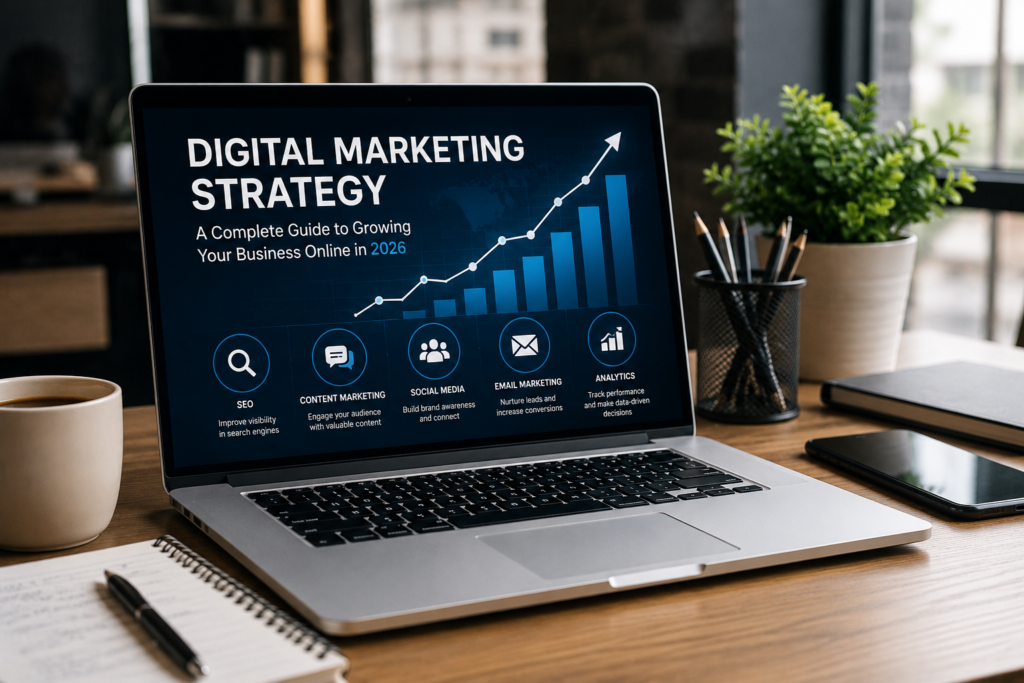
In today’s fast-changing digital landscape, simply having a website or an active social media page is no longer enough. Businesses need a clear Digital Marketing Strategy to connect with the right audience, strengthen customer relationships, generate quality leads, and achieve sustainable growth. Instead of relying on random marketing efforts, a structured strategy ensures that every campaign supports your business goals and delivers measurable results.
Whether you’re running a startup, a local business, or an established company, a well-planned strategy helps you make smarter marketing decisions and maximize your return on investment. By combining the right digital channels with consistent planning, businesses can improve their online presence, attract the right customers, and stay ahead of the competition.
What is a Digital Marketing Strategy?
A Digital Marketing Strategy is a long-term plan that explains how a business will use digital channels to achieve its marketing objectives. It involves research, planning, execution, and continuous optimization to improve online visibility and overall business performance.
A successful strategy helps businesses:
- Reach the right audience
- Build brand awareness
- Generate quality leads
- Increase customer engagement
- Improve marketing performance
- Measure business growth
Unlike short-term campaigns that focus on immediate results, a strategy is designed for long-term success. It allows businesses to monitor performance, learn from data, and continuously improve their marketing efforts.
Why Every Business Needs a Digital Marketing Strategy
Successful businesses don’t depend on guesswork. They follow a structured marketing plan that helps them stay focused and competitive. A strong Digital Marketing Strategy provides direction, improves decision-making, and ensures that every marketing activity contributes to business growth.
Understand Your Audience Better
Knowing your audience is the foundation of successful Digital Marketing. Understanding customer interests, demographics, online behavior, and buying patterns helps businesses create personalized marketing campaigns that solve real customer problems.
When you know what your audience is looking for, it becomes easier to create valuable content, improve customer engagement, and build long-lasting relationships.
Make Better Marketing Decisions
Good marketing decisions are based on data, not assumptions. With Marketing Analytics, businesses can monitor website traffic, customer behavior, conversions, and campaign performance in real time.
These insights help identify successful campaigns, highlight areas that need improvement, and support better decision-making. Businesses that regularly analyze marketing data are more likely to improve their marketing performance and achieve consistent growth.
Improve Marketing Efficiency
Without a proper strategy, businesses often spend time and money on marketing activities that don’t produce meaningful results. A well-planned Strategic Digital Marketing approach helps prioritize the most effective marketing channels while improving overall efficiency.
Instead of trying every platform, businesses can focus on channels that deliver the highest return and align with their business objectives.
Support Long-Term Business Growth
A successful marketing strategy creates consistency across every digital channel. Whether you’re using SEO Services , Google Ads, Social Media Marketing, or Email Marketing, every activity should work together to achieve the same business goals.
When all marketing efforts follow a clear strategy, businesses build stronger brand awareness, improve customer trust, and create sustainable business growth.
Essential Elements of a Successful Digital Marketing Strategy
Every effective strategy is built on key elements that work together to drive long-term success.
1. Set Clear Business Goals
Every marketing strategy starts with clearly defined objectives. Without clear goals, it becomes difficult to measure progress or evaluate success.
Your goals may include:
- Increasing website traffic
- Generating quality leads
- Improving customer engagement
- Building brand awareness
- Increasing online sales
Setting specific and measurable goals helps businesses stay focused while making future marketing decisions much easier.
2. Know Your Target Audience
Before launching any marketing campaign, businesses should understand:
- Customer interests
- Pain points
- Online behavior
- Buying journey
- Preferred digital platforms
The better you understand your audience, the easier it becomes to create content that provides value and encourages meaningful engagement.
3. Use AI to Improve Marketing Performance
Modern businesses are increasingly adopting AI Digital Marketing to work more efficiently and make better marketing decisions. Instead of replacing human creativity, AI helps marketers save time and improve the overall quality of their campaigns.
With the help of AI, businesses can:
- Analyze customer behavior
- Generate content ideas
- Improve personalization
- Optimize marketing campaigns
- Save valuable time
When used correctly, AI becomes a powerful support tool that allows marketing teams to focus on strategy, creativity, and customer experience.
4. Automate Repetitive Marketing Tasks
Managing multiple marketing activities manually can be time-consuming. Marketing Automation helps businesses automate repetitive tasks such as email scheduling, customer follow-ups, lead nurturing, and reporting.
By automating routine work, marketing teams can spend more time on planning, strategy, and business growth instead of handling repetitive processes.
Create High-Quality Content
Content plays a key role in every successful Digital Marketing Strategy. High-quality content helps businesses educate their audience, answer common questions, and build trust over time.
Rather than creating content only for search engines, businesses should focus on providing useful information that solves real customer problems.
A well-planned Content Marketing Strategy helps businesses:
- Build trust with customers
- Improve customer engagement
- Increase brand awareness
- Strengthen long-term customer relationships
Some popular content formats include:
- Blog posts
- Case studies
- Videos
- Infographics
- Industry guides
- FAQs
Publishing valuable and consistent content also improves your website’s authority and attracts the right audience over time.
Track Performance with Marketing Analytics
Creating a strategy is only the beginning. Measuring its performance is equally important. Marketing Analytics allows businesses to understand customer behavior, evaluate campaign performance, and make informed decisions based on real data.
Some important metrics include:
- Website traffic
- Bounce rate
- Conversion rate
- Lead quality
- User engagement
- Customer acquisition cost
- Marketing ROI
Reviewing these metrics regularly helps businesses identify successful campaigns, improve weaker areas, and achieve long-term business growth.
The Role of AI Marketing Tools in Modern Business
Technology continues to transform digital marketing, and AI Marketing Tools are becoming an important part of modern marketing strategies. These tools help businesses automate repetitive tasks, understand customer behavior, improve content planning, and generate useful insights.
Some common applications of AI include:
- Content planning
- Keyword research
- Audience segmentation
- Campaign optimization
- Performance reporting
When businesses combine AI with human expertise, they can make smarter decisions, improve productivity, and save valuable time.
Common Mistakes to Avoid
Even a well-designed marketing strategy can fail if important fundamentals are ignored. Some common mistakes include:
- Setting unclear business goals
- Ignoring customer research
- Publishing inconsistent content
- Not analyzing marketing performance
- Depending on only one marketing channel
- Ignoring changing customer behavior
Avoiding these mistakes helps businesses build a stronger online presence and improve long-term marketing results.
How to Build a Future-Ready Digital Marketing Strategy
The digital landscape continues to evolve, and businesses must adapt to remain competitive. A future-ready Digital Marketing Strategy focuses on continuous improvement instead of one-time success.
To stay ahead, businesses should:
- Understand customer needs
- Use Marketing Analytics for better decision-making
- Leverage AI Digital Marketing to improve efficiency
- Implement Marketing Automation where appropriate
- Continuously test and optimize marketing activities
Businesses that embrace new technologies while keeping customers at the center of their strategy are more likely to achieve sustainable business growth.
Conclusion
A successful Digital Marketing Strategy is much more than promoting products or services online. It provides a clear roadmap that helps businesses understand their audience, create valuable content, measure performance, and improve marketing efforts over time.
By combining Strategic Digital Marketing, Marketing Analytics, Marketing Automation, AI Digital Marketing, and AI Marketing Tools, businesses can make smarter decisions, improve customer engagement, and achieve long-term business growth.
If you’re looking to build a results-driven marketing strategy, now is the right time to invest in a structured approach that supports sustainable online growth.
Frequently Asked Questions (FAQs)
What is a Digital Marketing Strategy?
A Digital Marketing Strategy is a structured plan that helps businesses achieve their marketing goals by using the right digital channels, understanding customer behavior, and making data-driven decisions.
Why is Marketing Analytics important?
Marketing Analytics helps businesses track campaign performance, understand customer behavior, measure marketing ROI, and make informed decisions for continuous improvement.
How does AI Digital Marketing help businesses?
AI Digital Marketing improves efficiency by automating repetitive tasks, analyzing customer behavior, personalizing marketing campaigns, and supporting better decision-making.
What are AI Marketing Tools?
AI Marketing Tools are software solutions that help businesses with keyword research, content planning, campaign optimization, audience analysis, and performance reporting.
Why is Marketing Automation important?
Marketing Automation helps businesses save time, improve consistency, automate repetitive marketing tasks, and increase overall marketing efficiency while supporting long-term business growth.
Hi, this is a comment.
To get started with moderating, editing, and deleting comments, please visit the Comments screen in the dashboard.
Commenter avatars come from Gravatar.